
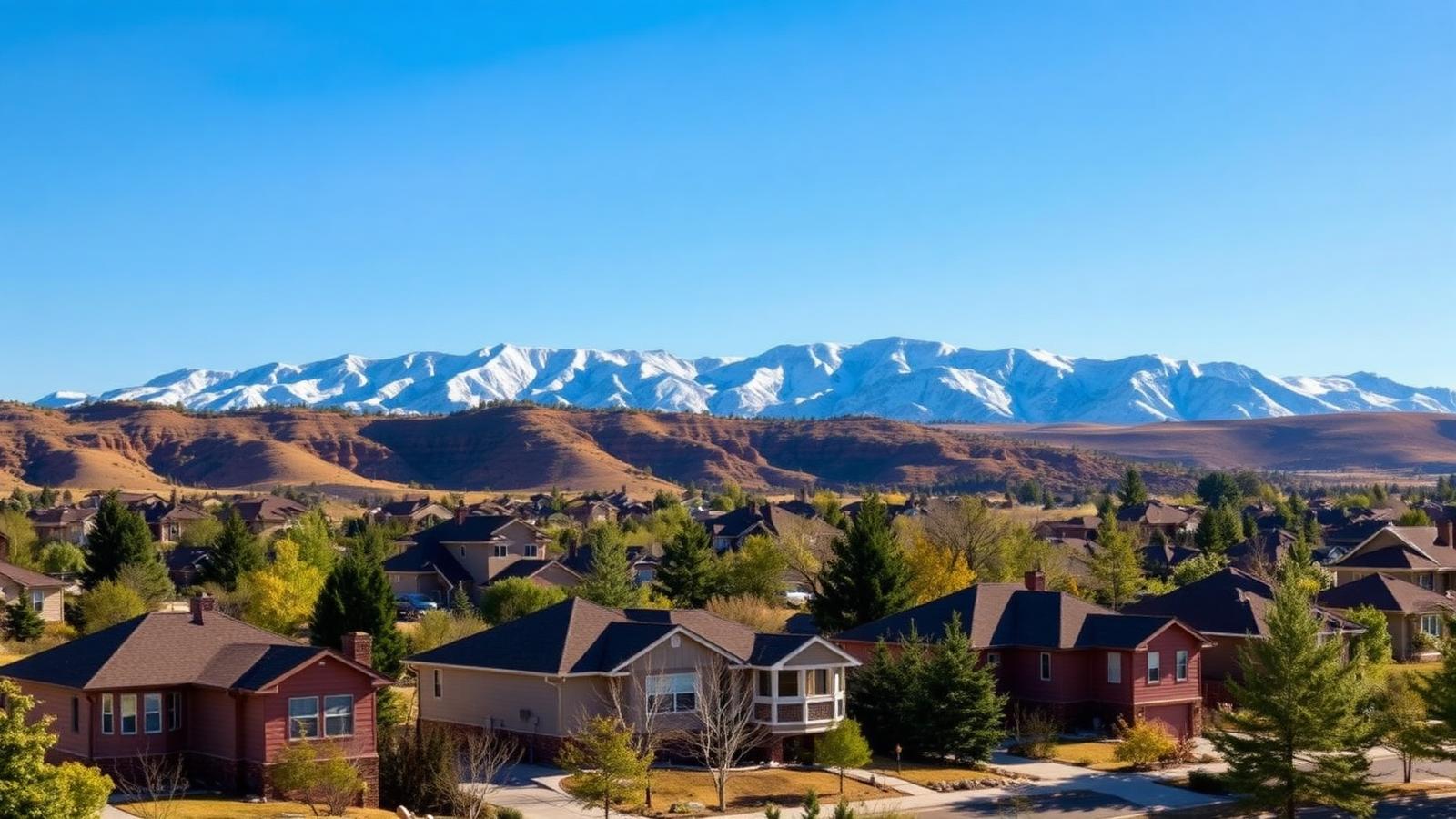
Moving from California to Colorado
What Your California Equity Buys in Colorado
A straight comparison of price, space, taxes, and monthly cost, plus a closing cost credit when you buy in Colorado.
Equity comparison
California versus Colorado, side by side
- Typical home price
- $785,000
- $545,000
- Square footage
- 1,650 sq ft
- 1,950 sq ft
- Annual property tax
- $8,600 / year
- $3,100 / year
- Estimated monthly payment
- $4,900
- $3,550
Illustrative Front Range medians, replaced with your own figures in the equity report. Colorado taxes a small percentage of actual value under its residential assessment rate, which is why bills stay modest even at high prices.
Why California homeowners choose Colorado
Colorado is the smallest equity gain on this list, and buyers should know that going in. Denver and Boulder are expensive by any standard other than coastal California. What Colorado offers instead is a genuine job market, a flat and modest income tax, and an outdoor life that Californians rarely feel they have downgraded into.
The real costs are insurance and altitude. Colorado sits in the most active hail corridor in the country and homeowners premiums have risen faster here than almost anywhere, frequently with a separate percentage roof deductible. Wildfire underwriting has tightened along the foothills after the Marshall Fire. And altitude is not a joke for everyone: Denver at a mile and Colorado Springs higher still affect sleep, exercise, and some cardiac conditions for the first months.
Locally understood, rarely disclosed to newcomers: metropolitan district debt. Many newer Front Range subdivisions are financed through metro districts that levy their own mill levy on top of county tax, and the combined bill can be double a neighboring older subdivision at the same price. Second, Colorado water is governed by prior appropriation, so a rural well permit may legally limit you to household use only, with no outdoor irrigation or livestock. If mountain living is the goal at a lower price, compare Montana and Idaho.
Cost of living versus California
Denver's overall cost sits below the California coast and above almost every other interior Western city. Groceries and dining are close to California levels. Utilities are moderate, with cheap natural gas offsetting winter heating.
The savings for most movers come from housing and income tax rather than day-to-day spending, and they are real but smaller than Texas or Tennessee.
- Overall cost index vs California
- About 15% lower
- Median housing cost
- About 31% lower
- State income tax
- Flat, roughly 4.4%
- Homeowners insurance
- Among the highest in the country due to hail
Taxes: what actually changes
Colorado's flat income tax sits in the low fours and applies to federal taxable income, which makes the calculation unusually simple. Under the TABOR amendment, surplus revenue is refunded to taxpayers, so the effective rate drops in strong years.
Property tax is low relative to home values because residential property is assessed at a small fraction of actual value. Effective rates commonly land near 0.5% to 0.6%, though metro district levies can push a specific parcel far above that.
State sales tax is 2.9%, but home rule cities add their own, pushing combined rates past 8% in parts of the metro. There is no estate tax, and there is a meaningful pension and annuity income exclusion for residents 55 and over.
The housing market
Inventory has loosened along the Front Range compared with the frenzy of a few years ago, and sellers are again paying concessions, which stacks well with a closing credit. Competition remains sharp in Boulder County and in the older, walkable Denver neighborhoods where nothing new can be built.
New construction concentrates north and east, in Erie, Thornton, Aurora, and Castle Rock, and that is exactly where metro district levies are most common. Read the tax certificate, not the listing.
Two Colorado-specific inspection items: expansive bentonite clay soils that heave foundations, which is why structural engineering reports are common here and rare in California, and radon, which is present at actionable levels across most of the Front Range and routinely requires mitigation.
Where people land in Colorado
Colorado Springs
Substantially cheaper than Denver with military and defense employment, the main value play.
Fort Collins
University town at the north end, best combination of walkability and access to the mountains.
Littleton
Established south metro suburb with mature trees and no metro district assessments.
Loveland
Quieter northern market, strong medical employment, lower entry price than Fort Collins.
Grand Junction
West Slope desert climate, mildest winters in the state, roughly half Denver's price.
Castle Rock
Between the two metros with top-rated schools, heavy new construction.
See what your California equity buys in Colorado
Get your personalized equity report, an introduction to a vetted Colorado agent, and a closing cost credit at your purchase. Free, and there is no obligation.
Start your Colorado move
Four short questions. We use them to decide which agent fits your move, and to build your equity report.